Currently Empty: ₨ 0

0 Comments
Lifting a motor out of a pump house, pulling a gearbox for repair or moving a machine in a workshop: most factories in Pakistan do this with a chain hoist. Choosing the right one comes down to four questions: how heavy is the load, how high do you need to lift it, how often will you lift, and what power do you have on site. This guide walks through each one.
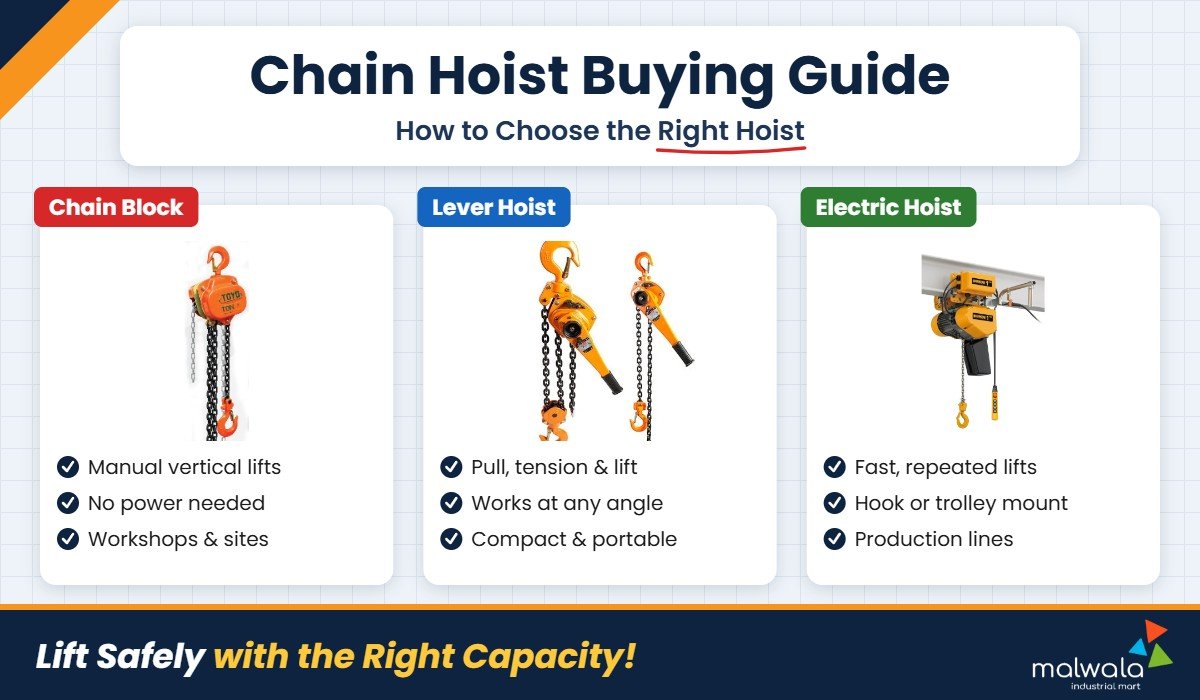
The main types of hoist
| Type | Best for | Power needed |
|---|---|---|
| Manual chain block (chain pulley hoist) | Occasional lifts in workshops, pump houses and maintenance work | None (hand chain) |
| Lever hoist | Pulling, tensioning and lifting in tight spaces, any direction | None (lever) |
| Electric trolley hoist | Frequent lifts on production lines and beams | Electric supply |
| Pneumatic (air) chain hoist | Heavy-duty, continuous use and areas where electrical sparks are a risk | Compressed air |
Manual chain blocks
A chain block hangs from a beam or hook and lifts the load when you pull the hand chain. It needs no electricity, is simple to maintain and is the most common choice for maintenance teams. Brands such as Toyo, Vital, Elephant and Hitachi chain blocks are widely used in Pakistani industry.
Lever hoists
A lever hoist works with a ratchet handle instead of a hand chain. It can lift, pull or hold tension at any angle, so it is useful for aligning machinery, tensioning cables and work in tight spaces where a hand chain cannot hang freely.
Electric and pneumatic hoists
When you lift many times a day, a powered hoist saves time and labour. Electric hoists suit most factories with a reliable supply. Air hoists run on compressed air, handle continuous duty well and are preferred where sparks from electrical equipment are a hazard.
How to choose the right capacity
- Know the real weight. Check the nameplate or manual of the machine, and add the weight of anything attached to it.
- Pick a hoist rated above the load. Never lift more than the rated capacity (working load limit) marked on the hoist. If the load is close to the limit, go one size up.
- Count the rigging. Slings, shackles, clamps and beams must each be rated for the load too. The weakest part sets the limit for the whole lift.
Lift height and mounting
Lift height is the distance the hook can travel. Measure from the beam or hanging point down to the lowest point you need to reach, and order the hoist with enough chain for that height. Standard hoists come with a fixed chain length, so tell your supplier if you need more.
- Fixed point: hang the hoist from a lifting lug, hook or a girder clamp on an I-beam.
- Moving along a beam: use a hoist with a trolley so the load can travel along the beam.
- No beam overhead: a tripod hoist stand gives a temporary lifting point for wells, manholes and site work.
Rigging you will also need
- Chain slings (2-leg or 4-leg) to hold the load evenly.
- Lifting shackles to connect slings, hooks and lifting points.
- A spreader beam for long or wide loads that need two lifting points.
- A snatch block to change the direction of a pull or rope.
Safety checks before every lift
- Check the hook, safety latch and chain for cracks, bends, stretched links or wear.
- Make sure the hoist is hanging straight above the load. Do not side-pull or drag loads with a hoist.
- Lift a few centimetres first and check that the brake holds before lifting higher.
- Never stand or work under a suspended load.
- Have hoists and slings inspected regularly and keep test certificates where your factory or client requires them.
Buy chain hoists and lifting equipment in Pakistan
Malwala supplies manual chain blocks, lever hoists, electric and air hoists, and the slings, shackles and clamps that go with them, with delivery anywhere in Pakistan. Send us the load weight and lift height on WhatsApp at +92 317 4727853 and we will suggest the right hoist and rigging for the job.