
Currently Empty: ₨ 0

0 Comments
Machines vibrate. Pumps, gearboxes, motors and conveyors shake their bolts loose over time, and a loose bolt is how small maintenance jobs turn into breakdowns. Loctite threadlockers fill the gaps between the threads and cure into a solid plastic that stops the bolt from turning. The hard part is choosing the right one, because the wrong grade either fails to hold or makes the bolt impossible to remove later.
This guide explains the main Loctite products used in Pakistani factories and workshops, what each one is for, and how to apply them so they work the first time.
Quick answer: which Loctite should I use?
| Job | Product | Why |
|---|---|---|
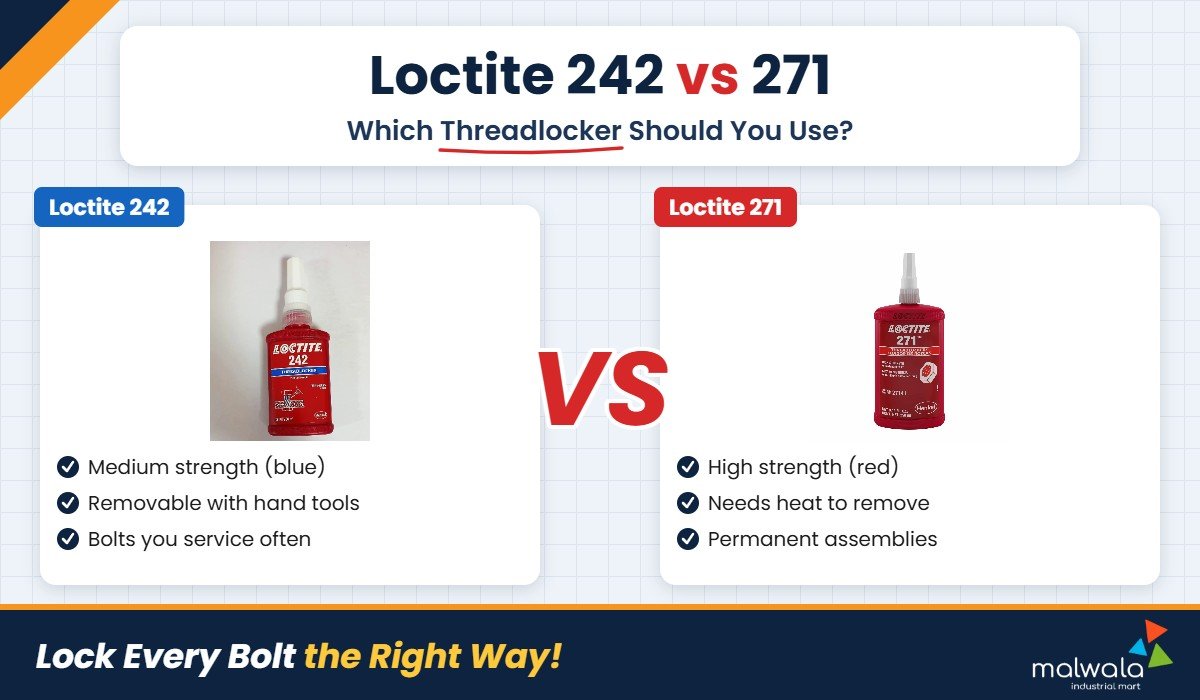
| Bolts you will need to open again (pump covers, motor mounts, gearbox bolts) | Loctite 242 (blue, medium strength) | Holds against vibration but can be removed with normal hand tools |
| Bolts that should never come loose (studs, foundation bolts, heavy equipment) | Loctite 271 (red, high strength) | Permanent lock; needs heat to remove |
| Bearings, bushes and gears on shafts | Loctite 638 retaining compound | Made for cylindrical fits, not threads |
| Pipe threads for air, water, oil and gas lines | Loctite 577 thread sealant | Seals pipe threads instead of PTFE tape |
| Flanges and covers that need a gasket | Loctite 510 gasket sealant | Forms the gasket in place on rigid metal flanges |
Blue vs red: medium and high strength threadlockers
Loctite 242: medium strength (blue)
242 is the general-purpose choice for fasteners up to about M20 (3/4 inch). It stops vibration loosening, but the bolt can still be undone with a normal spanner when you need to service the machine. Use it on anything that maintenance teams will open again: pump casings, motor base bolts, bearing housings and machine guards.
Loctite 271: high strength (red)
271 is for fasteners up to about M25 (1 inch) that should stay locked for good, such as studs, heavy equipment bolts and foundation bolts. Once cured it is very hard to remove with tools alone. To open it, heat the joint (roughly 250 °C) and undo it while it is still hot.
Rule of thumb: if you are not sure, choose blue. You can always upgrade to red later, but a red joint you need to open becomes a problem.
Not a thread? Use the right product instead
- Bearings and bushes on shafts: threadlockers are made for threads. For slip fits and press fits on cylindrical parts use a retaining compound like Loctite 638.
- Pipe threads: for hydraulic, pneumatic and water fittings use a thread sealant such as Loctite 577. It seals and does not shred like tape.
- Flanges and covers: on rigid machined flanges, Loctite 510 replaces cut gaskets and will not shrink or crack.
How to apply a threadlocker properly
- Clean the threads. Oil and old grease stop the product from curing. A cleaner such as Loctite SF 7063 removes oil and dries quickly.
- On stainless steel, zinc-plated bolts or in cold weather, use a primer or activator such as Loctite SF 7471 so the product cures fully.
- Apply a few drops on the bolt threads where the nut will sit. For blind holes, put drops down into the hole as well.
- Assemble and tighten to the normal torque.
- Leave it to cure. Most threadlockers can be handled after a short time and reach full strength in about 24 hours at room temperature.
Common mistakes we see
- Using red 271 on bolts that need regular maintenance.
- Applying on oily threads straight out of the machine.
- Using a threadlocker on pipe threads or bearing fits instead of the correct sealant or retaining compound.
- Running the machine at full load before the product has cured.
Buy Loctite in Pakistan
Malwala supplies genuine Loctite threadlockers, retaining compounds, sealants, cleaners and primers for factories and workshops across Pakistan, with bulk pricing for maintenance teams. Not sure which grade fits your job? Send us the bolt size and application on WhatsApp at +92 317 4727853 and we will recommend the right product.